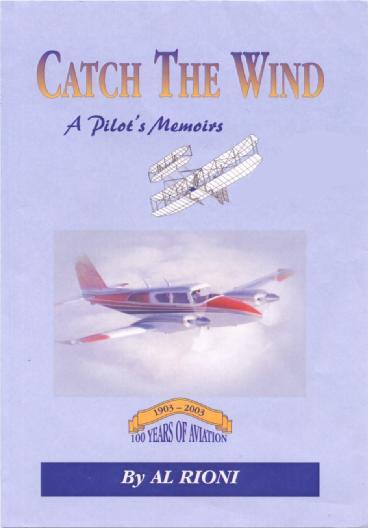
**
This book contains descriptions of the more unusual events which occurred during a long flying career.
**
It should be remembered that these unusual events were isolated incidents and the vast majority of my flights were routine, uneventful, and often boring (which is the way I liked them to be).
**
However, boring flights do not make interesting reading.
**
One should remember, when one flies for 8 to 10 hours a day for many years, that strange, unusual, and interesting things are bound to happen, once in a while.
**
While the unusual events described in this book may seem common, they were rare exceptions, not the rule.
**
In addition, and even more importantly, it must also be remembered that the actions of one young, inexperienced, and sometimes foolish person, must not reflect on the entire aviation community.
**
It has been my experience that the vast majority of pilots, (including myself - after gaining the wisdom that comes with age and maturity), are conscientious, extremely cautious, and dedicated to safety.
**
The events described in this book would never be repeated today.

**
One hundred years ago, Orville and Wilbur Wright, two bicycle shop owners from Dayton Ohio, changed the world forever with the invention of the airplane . . . . The World owes them an enormous debt.
**
This book is dedicated to the spirit of flight . . . . and to the spirit of American freedom.
**
It is fitting it should be told now - during the celebration of the Centennial Anniversary of Aviation.
Page 4
___________________________________
Catch The Wind
Chapter 3
-- March 1968 -- 3 Years Earlier --
**
This chapter describes some events a student pilot may experience
while learning to fly.
**
It describes the problems and challenges a student
pilot faces when trying to fly alone in an airplane
after only a few hours of flight lessons.
* * * * * * * *
Pages 40 thru 46 Of This Chapter Describe
The Anxiety, Uncertainty And Innermost
Thoughts of A Student Pilot On A
First Solo Flight - - All Alone In The Sky
We Begin This Chapter on Page 47
* * * * * * * *
**
The weather the evening of that first solo flight was very calm and tranquil. The windsock hung limply on its mast.
**
Getting lower and lower on final approach to the runway, it seemed as though a mystical force had taken over the airplane . . . I was lightheaded . . . It was almost a delirium.
**
It was an eerie feeling.
**
It seemed like someone else was flying the airplane.
**
Although everything seemed normal, I wasn’t sure I could really land the airplane and briefly considered abandoning the attempt, applying engine power, and climbing up and away from the rapidly approaching runway.
**
However, in a battle between emotion and logic, I kept descending and forced myself to accept the fact that there was no escaping the reality of the situation and any such action would only delay the inevitable.
**
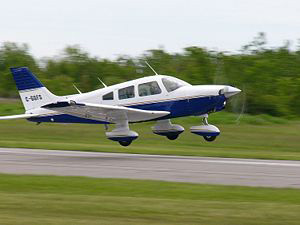
So down I went, airspeed at 80 miles per hour, engine power at 1600 RPM’s, wing flaps set at 25 degrees, power off over the runway threshold . . . hold the
nose up.
**
Then, the mild and familiar screech as the main wheels, and then the nosewheel, contacted the ground.
**
Flaps up - full power for the next take-off - steer straight down the runway.
**
WOW, I did it.
**
The first solo flight of a student pilot normally requires 3 take-offs and landings.
**
During the remaining 2 traffic pattern circuits, I began to feel more and more at home in the airplane, and, very much at home in the air.
Page 47
___________________________________
**
After the final landing on that first solo flight, while taxiing back to the parking ramp, I saw my flight instructor waiting for me, nervous but smiling.
**
He performed the traditional ritual, after a students first solo flight, of ripping off the tail portion of my shirt.
**
With a marker, he wrote my name and the date on this torn piece of shirt and hung it on the wall of the Flight School Office along with the shirt tails of the other students who solo-ed at our school.
**
On the drive home, wearing my torn shirt, I still had that eerie and dazed feeling of numbness in my head.
**
I realized something within me was different.
**
I still couldn’t believe I had actually done it.
**
I knew I had changed forever . . I could fly . . I was a pilot.
**
I also re-discovered some strange feelings I had experienced earlier in my life and never forgot.
**
As I believed I was not really ready to solo that evening, I was somewhat confused that I was able to take-off in the airplane knowing I may not be able to land it.
**
It was the same awareness of being calm under stress, and lack of emotion or fear, I felt in the Emergency Room of the hospital after a near fatal accident a couple of years earlier.
**
I discovered that I also seemed to be able to shut off fear and emotion while flying an airplane.
**
Or, having come so close to dying before, and survived, maybe I had lost some of my fear of death.
**
I spent the next several days and nights in deep thought about that first solo flight. During that flight, it felt like I had been introduced to a stranger living inside me . . . . . a cold, robot-like, emotionless Pilot.
**
That same stranger seemed to re-appear many times during my flying career in times of extreme stress and danger.
Page 48
___________________________________
**
After that first solo, I tried to fly on a more regular schedule but still struggled to save money for the flight lessons and still got airsick on those early solo flights.
**
After a few hours of solo touch and go’s in the airport traffic pattern, the student is checked out for solo flight to and from the school practice flying area, which is in a valley about 10 miles North of the Westfield/Barnes Airport.
I remember flying back to Westfield from the practice area with my head resting on the side window of the airplane and the terrible feeling of nausea in my stomach.
**
After about 5 flights and 5 hours of solo flight in the practice area, the student is ready to begin the next stage of the Private Pilot curriculum. This next stage is the “cross-country” training. ( A cross-country flight is any flight that includes a landing at an airport which is at least 50 miles from the departure airport.)
**
The student once again flies with an instructor on a series of “Dual cross-country” flights.
**
When the instructor feels the student is capable of conducting cross-country flights alone, the instructor authorizes the student for “Solo cross- country” flights.
**
This usually requires about 3 or 4 training flights with the Instructor and requires the endorsement “OK for solo cross-country” in the students training logbook.
**
Traditionally, the student pilot, upon landing at this new airport on these solo cross-country flights, asks someone there to sign his or her training logbook to verify that the student actually arrived at the airport as planned.
**
This logbook signing can be done by anyone at the airport.
**
Aero Aviation had regular airports to which they sent their students on these solo cross-country flights.
Page 49
___________________________________
**
The first solo cross-country flight was from Westfield to Keene New Hampshire, a trip of about 60 miles.
**
(It is very easy for a student pilot to get lost on a cross-country flight. The student may incorrectly set, or mis-read the gyro-compass, forget to note the time of take-off, become confused by similar looking ground terrain, or many-many other things).
**
But, there were a couple of reasons why it was difficult for the student to get lost on this first solo flight from Westfield to Keene.
**
The first reason was, although the student completed the usual pre-flight preparations and planning, including checking the current and forecasted weather, plotting the course on an aviation chart, computing the effects of the winds aloft, determining fuel requirements, locating and identifying visual ground checkpoints, and many other things, it was difficult to get lost because all the student pilot really had to do was follow the Connecticut River all the way from Westfield to Keene.
**
The second reason it was difficult for the student to get lost on this first solo cross-country flight was that the Keene Airport was one of the airports the student had already been to on one of the previously conducted “dual cross-country” flights with the Instructor.
**
Therefore, the student was somewhat familiar with the route and with the Keene Airport.
**
It was an easy and confidence building flight.
**
The second solo cross-country flight was a little more complicated, as it included landings at two different airports before returning to Westfield.
**
The students flew to the airport at Laconia New Hampshire, which is about 100 miles Northeast of Westfield.
Page 50
___________________________________
**
From Laconia, the students flew South for about 70 miles to the airport at Danielson Connecticut.
**
From Danielson, they then flew Northwest for about 50 miles, back to Westfield.
This longer flight required the students to be aware of and properly manage the airplanes fuel system.
**
The third and final solo cross-country flight was from Westfield to the airport at Fitchburg Massachusetts, which is about 70 miles Northeast of Westfield.
**
From Fitchburg, the students flew South for about 40 miles to the airport at Worcester Massachusetts, and then back to Westfield.
**
The Worcester Airport was the only one of these airports, other than Westfield, with an operating control tower.
**
On the training cross-country flights with the instructor, student pilots are taught the proper and simple procedures for landing and taking off from “Un-controlled” (Non-tower) airports.
**
Basically, these are “See and be seen” procedures. The students, while watching for other air traffic, may radio the airport operations office (If any), or, may locate visual wind and other active runway indicators, (Such as the airport wind-sock), or, may follow existing air traffic.
**
After choosing the proper runway, the students must properly space themselves in the airport traffic pattern with any other aircraft which may be using the airport.
**
(All Air Traffic Control procedures, including tower
and non-tower airport operations, are described in
detail in the FAA published “Aeronautical
Information Manual” (AIM) which all student pilots
are required to study).
Page 51
___________________________________
**
The cross-country flights were a little more difficult for me to schedule as they consumed much more flight time and were much more expensive.
**
I sometimes had to save for weeks before accumulating enough money to pay for these longer flights.
**
The first and second of my solo cross-country flights were uneventful. The destination airports were where I computed them to be and appeared in front of my airplane at the pre-determined times.
**
Upon landing, I had my training logbook signed and returned to Westfield.
**
(While a student pilot is required to navigate the
airplane using basic, traditional, and somewhat
primitive navigation methods, we were fortunate
there was a VOR transmitter at the Westfield
Airport.
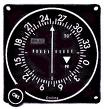
A VOR (VHF Omni-directional Range) is an easy
to use aircraft radio navigation beacon/system.
Student pilots at Westfield were aware we could
receive the Westfield VOR from almost anywhere
along the routes of these solo cross-country flights.
Although we were not supposed to use the VOR
navigation system on our training flights, it was
comforting to know that, if we became lost, we
could simply tune in the Westfield VOR and home
in on it.)
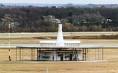 VOR Transmitter
 VOR Instrument
**
My third and final solo cross-country flight was scheduled on a Sunday afternoon in April of 1968.
**
I arrived at the airport at about 3:30 PM and completed my flight planning. I computed that the round-trip from Westfield to Fitchburg to Worcester and back to Westfield would take about 2.5 hours.
Page 52
___________________________________
**
At 3:45, my instructor checked my flight planning and endorsed my logbook, authorizing me to make this solo cross-country flight. He then left the airport as he had some important family matters to attend to.
**
I was scheduled to take-off at 4:00 PM. However, the previous student, who had been using the airplane I was scheduled to use, was late taking off and did not bring the airplane back until 5:00 PM. I had the airplane re-fueled, performed the pre-flight inspection, and took-off at 5:30 PM.
**
The 70 mile flight from Westfield to Fitchburg was uneventful until I got close to Fitchburg. Nearing the Fitchburg Airport, the weather, which had been forecast to be good, had begun to deteriorate.
**
There were some low clouds beginning to form.
**
However, I landed at Fitchburg without incident, parked on the ramp, and began to look for someone to sign my logbook. It was getting late and there were few people around. I found a waitress in the restaurant to sign my logbook, confirming my arrival at Fitchburg.
**
By now, the Sun was setting and it was getting dark.
**
As mentioned earlier, my flight training had been sporadic, to say the least. I spent most of my time working and worrying about how to get the money for the next lesson. I didn’t spend a lot of time at the airport between lessons and rarely talked to other students.
**
Using a home study course, I had already taken and passed the FAA Private Pilot Written Examination, which is required before receiving the Private Pilots License.
Page 53
___________________________________
**
This test includes knowledge of the FAA Regulations pertaining to night flying and to weather avoidance procedures and requirements.
**
However, although many years have passed since those days, I do not recall being familiar with the legal requirements for flight within the clouds or flying at night.
**
Therefore, that evening, taking off from Fitchburg, although I should have known better, I was completely unaware that student pilots do not fly at night, nor, that flight within the clouds, without an Instrument Rating, and without an Air Traffic Control clearance, is illegal.
**
As I learned to drive a car a couple of years earlier, and as there was no special training required to drive a car at night, I never even considered that there may be any difference between day flying and flying at night.
**
So, that evening, I just kept on going to Worcester.
**
(Night flying is, in fact, very different and much
more difficult than flying in the daytime.
Many things, such as the ground, the horizon
clouds, obstructions, airports, and other things,
which are easily visible in the daylight, are much
more difficult to see and identify at night.
Distances are also much more difficult to estimate
at night.
Visual flying (VFR) at night is considered to be so
difficult and potentially dangerous that most
countries permit only Instrument (IFR) flying at
night.
In fact, the US is the only country on Earth that
allows visual (VFR) flying at night.
IFR flights require the pilot to be licensed, have an
Instrument Rating, and be flying in accordance
with an Air Traffic Control clearance).
Page 54
___________________________________
**
Climbing out from Fitchburg that evening, as it was dark in the airplane, it was necessary to turn on the airplanes lights.
**
However, the instrument panel was dark and I couldn’t see the flight instruments, didn’t have a flashlight, and didn’t know the location of the airplanes light switches.
**
I couldn’t see my charts nor my flight plan form on which was written my planned heading, the visual ground checkpoints, and the times I had determined would be required to fly between these checkpoints.
**
However, I wasn’t overly concerned and considered these problems to be only inconveniences, as they would have been for a new driver the first time he or she attempted to drive a car at night.
**
I recalled that there was an overhead light on the ceiling of the cabin and reached up and turned on the switch next to this light.
**
The light went on and lit up the inside of the cabin.
**
I then looked around and found the switch that turned on the instrument panel lights and the outside position lights on the ends of the wings and tail.
**
Next to that switch was another switch which turned on the red rotating beacon on the tail of the airplane.
**
Satisfied, I continued on to Worcester, totally unaware that I might be doing anything wrong.
**
Taking off from Fitchburg, I noticed there were more clouds forming and the wind speed had increased substantially out of the South.
**
The wind sock was straight out during the take-off.
**
I had computed the time required to fly from Fitchburg to Worcester to be about 25 minutes. On the flight plan form prepared for this leg of the flight, I had written my computed compass heading and the ground checkpoints over which I would be flying.
Page 55
___________________________________
**
After turning on the panel lights, I was able to maintain this heading on the compass/gyro, but, because the ground was dark, I couldn’t find any of my checkpoints.
**
Still unconcerned, I decided that, instead of trying to find these ground checkpoints, I would look for the lights of the City of Worcester and then try to locate the Airport from there.
**
It didn’t seem to be a big problem.
**
I noticed that, from time to time, that there was a large red glow appearing out in the darkness near the end of the left wingtip, and there was also a large green glow out toward the end of the right wingtip.
**
In addition, there was rhythmic pulsing of red light illuminating the air all around the outside of the airplane.
**
The lights on the ground kept disappearing.
**
I soon realized I was flying through the clouds.
**
The airplanes red and green position lights on the wingtips, and the red rotating beacon, reflecting off the heavy moisture inside the clouds, was causing these light glows around the airplane.
**
Because I was in the clouds and could not see the ground, I had to maintain my heading and altitude by reference to the flight instruments.
**
This was a little difficult at first as instrument flying requires a lot of concentration and it had been some time since I practiced.
**
The airplane made a few unplanned turns and some other unexpected motions while I looked down at the charts, but I soon remembered not to look away from the instruments for too long and was able to keep the airplane under control.
**
Page 56
___________________________________
**
I decided, at that point, to forget about continuing on to Worcester and head back toward Westfield.
**
Because I was not departing from Worcester toward Westfield as planned, the flight plan form prepared for this leg would be useless as my new ground track back to Westfield would be different.
**
Still not overly concerned, I decided to simply head West until I could receive the Westfield VOR and then home in on it back to Westfield.
**
A short time after turning West, I flew out of the clouds and could see the ground again.
**
The light glows around the airplane were gone.
**
Just then, I looked on the ground to the right of the airplane and saw the flashing beacon light of an Airport.
**
Because of my confusion over the aircraft’s lights and the glowing lights around the airplane, I had lost track of the time.
**
I figured, in my confusion, I must have already passed Worcester and the Worcester Airport was the one I was seeing to my right.
**
I decided, since the Worcester Airport was so close, I might as well land there as previously planned.
**
I found the control tower radio frequency on the chart, set it into the communication radio, and called the Worcester Tower.
**
I reported I was a couple of miles South of the Worcester Airport and wanted to land. The Worcester Tower instructed me to enter their traffic pattern and call them again when on final approach to the runway.
**
I called the tower again turning onto final approach.
**
The Worcester Tower told me they didn’t yet have me in sight, but, I was cleared to land.
Page 57
___________________________________
**
I landed and taxied to the parking ramp. I recall thinking how much more difficult it was, in the darkness, to judge the distance above ground during the flare for landing.
**
While taxiing to the parking ramp, I remember thinking how similar this Worcester Airport was to the Fitchburg Airport from which I took-off a few minutes earlier and remember thinking that they were probably built from the same Government program, hence the similarity.
**
Stopping on the parking ramp, I saw a small building and remember thinking this ramp and this building looked very familiar. Still believing this to be the Worcester Airport, I looked at the sign on the side of the small building.
**
I had seen this sign very recently.
**
It said, “Welcome to Fitchburg”.
**
I was completely surprised, stunned, and dis-oriented.
**
This couldn’t be the Fitchburg Airport again, but it obviously was.
**
What a strange and eerie feeling it was to have believed you were at one place and to so suddenly discover that you were many miles away from where you thought you were.
**
I didn’t know how this could have happened.
**
My navigation had always been accurate.
**
It seemed like something out of the Twilight Zone.
**
This was a very humbling and shocking experience which left a lasting impression on me.
**
I learned that, in aviation, you must never be sure of anything.
It was a very valuable lesson in learning to fly.
**
As the Fitchburg Airport has no control tower, I quickly taxied back to the runway, took-off, climbed to 2500 feet, and headed West, back toward Westfield.
**
I tried to regain my composure and confidence.
**
I was soon back in the clouds again.
Page 58
___________________________________
**
I still wasn’t concerned for my safety, but I wasn’t sure if I had done anything illegal by calling the Worcester Tower, receiving landing instructions, and then not landing there.
**
They surely must be wondering what happened or why I called them and never landed.
**
I considered calling them on the radio to explain, but, I was still very confused and didn’t call them.
**
After leveling off, I tried to figure out what caused me to become so dis-oriented that I landed at the wrong Airport.
**
I remembered noticing, while taking off from Fitchburg the first time, that the wind had increased substantially from the South.
**
I concluded that, because of the low groundspeed caused by this strong and unforecast headwind, my airplane must not have traveled across the ground toward Worcester as fast as I had originally computed it would.
**
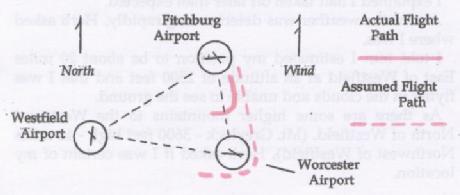
Because of this very low groundspeed, and because of the other navigation and orientation problems associated with flying at night, I was actually only a little South of Fitchburg, thinking I had already passed Worcester, when I made the right turn back toward Westfield.
**
The Airport I had seen to my right, and believed to be the Worcester Airport, was actually the Fitchburg Airport from which I had just departed. (See illustration below)
Page 59
___________________________________
**
I determined the return trip back to Westfield would take about 25 minutes.
**
I continued “Flying blind” back to Westfield and began to wonder how to see and find the Westfield Airport through the clouds and through the rain that was beginning to fall.
**
I decided to radio our flight school and ask them.
(This was the era before cell-phones were invented.)
**
I tuned the radio to the frequency used by our Flight School Office and called them. . . . .
**
**
All HELL broke loose.
**
A few minutes before I called, they realized I had not yet returned from my cross-country flight and they were frantic at the thought of me flying alone at night and through this approaching bad weather.
**
They had already begun to try to locate me and had telephoned the Worcester Airport Control Tower.
**
The Worcester Tower told them I called on the radio for landing instructions but did not land there and they were about to initiate search and rescue procedures.
**
The chief pilot of our flight school, Herb Barrett, was in the flight school office that evening when I radioed. He angrily asked what I was doing in the air at such a late hour.
**
I explained I had taken off later than expected.
**
Aware the weather was deteriorating rapidly, Herb asked where I was.
**
I told him I estimated my position to be about 20 miles East of Westfield at an altitude of 2500 feet and that I was flying in the clouds and unable to see the ground.
**
As there are some higher mountains to the West and North of Westfield, (Mt. Greylock - 3600 feet high - 40 miles Northwest of Westfield), Herb asked if I was certain of my location.
Page 60
___________________________________
**
I told him my VOR receiver indicated I was due East of the Westfield Airport and I had taken off from Fitchburg about 20 minutes ago.
**
He asked how much fuel was remaining on board.
**
I told him I was running on the left wing fuel tank and the gauge indicated it had 15 gallons of fuel in it and the right wing tank gauge indicated it contained 10 gallons of fuel.
**
This total of 25 gallons was enough fuel for about 2.5 hours of flight. We agreed this was enough fuel for now.
**
Herb asked how I was flying the airplane in the clouds without ground reference. Not knowing it was illegal, I told him I was flying on instruments. He sounded upset.
**
Herb said the weather was getting bad at Westfield and I may have to divert to nearby Westover Air Force Base.
**
Westover has military Precision Approach Radar (PAR) which enables the air traffic controllers to guide an airplane down through the clouds to the runway.
**
(Except in an emergency, which this event certainly
was, civilian aircraft are not allowed to land at
military airports).
**
I told Herb I was going to descend from 2500 feet down to 2000 feet in hopes I might see the ground and avoid having to go to Westover.
**
I knew 2000 feet was above 1500 foot Mt. Tom, the highest mountain between my position and the Westfield Airport
**
Herb told me not to descend, but, by the time he did, I had already descended to 2000 feet.
**
At 2000 feet, I still couldn’t see the ground. It was beginning to rain more heavily and I was in the clouds and couldn’t see more than a few feet around the airplane.
**
I decided to descend from 2000 feet down to 1800 feet without telling Herb.
**
At 1800 feet, I still couldn’t see the ground. I descended to 1700 feet. I knew I must be close to 1500 foot Mt. Tom by now. . . . I still couldn’t see the ground.
Page 61
___________________________________
**
I descended a little more.
**
At 1600 feet, I began to see some lights beneath the airplane. It was a city with factories and canals.
**
I recognized it as the city of Holyoke, which is about 3 miles East of Mt. Tom.
**
As it was still some distance to Mt. Tom, I descended a little more and finally dropped out of the overcast.
**
Through the rain and mist, Mt. Tom, and the ridge of mountains of which Mt. Tom is the highest point, was now visible and was approaching fast.
**
I headed toward the low point on the ridge, just South of Mt. Tom, further descended down to 1200 feet, and flew through the very narrow space between the top of the ridge and the bottom of the overcast.
**
As this space was so narrow, it was necessary to fly at treetop level until crossing the ridge and to stay as low as possible in order to avoid inadvertently flying back up into the clouds and losing sight of the ground again.
**
I was exhausted from flying on instruments for so long and didn’t want to go back up into the clouds.
**
Fortunately, I was able to get through this narrow gap and descend into the Westfield Valley. The top of Mt. Tom was in the clouds and not visible as I crossed the ridge.
**
Herb radioed and asked what was happening.
**
He sounded very upset . . . . He said he informed the Westfield Control Tower of the situation.
**
He also said the tower had turned up the runway lights to their maximum brightness and told him to inform me that I was cleared to land on any runway at the airport.
**
The weather was worsening and there were more low clouds. The airport was difficult to find. I used the VOR to try to determine a heading toward the runways.
**
Flying at tree top level, I could now only see straight down.
Page 62
___________________________________
**
The main runway at Westfield is over 9000 feet long, which is much longer than most civilian non-airline airport runways.
**
Passing over the airport boundary, I began to see the glow of the runway lights through the mist. I turned the airplane to the runway heading, descended into this glow, and while
struggling to switch my attention from keeping the wings level while flying on instruments, and looking outside for the lights, maneuvered the airplane over the very long runway while descending slowly.
**
I was finally able to see the bright lights and land at about three-quarters of the way down the length of the runway.
**
I was uncomfortable landing and taxiing without being in contact with the control tower, but, under the circumstances, and based on my conversations with Herb, I decided not to call the tower and to just taxi in to the parking ramp.
**
I wasn’t sure of how much trouble I was in because of the incident with the Worcester Control Tower, because I was flying at night, or because I was flying in the clouds.
**
I didn’t know what kind of reception I was about to receive and wondered if this was to be my last flight.
**
Taxiing toward our hangar, I saw a group of about 20 or 30 people waiting for me in the pouring rain .
**
They were some of the other students and instructors from our school and from the other flight school at the Airport, some of our office personnel, some spectators, and others.
**
As I approached our parking ramp, they all rushed toward my airplane. I was reminded of the scene from the movie “The Spirit of St. Louis”, when Charles Lindbergh landed in Paris on that historic flight and was overwhelmed and rushed by the crowds of people waiting there for him.
**
As spinning propellers are difficult to see, as this crowd neared my airplane, I had to shut down the engine before reaching my parking space in order to avoid having the propeller strike some of these on-rushing people.
**
I was glad I did.
**
I rolled to a stop in the middle of the parking ramp and got out.
Page 63
___________________________________
**
People were climbing all over the airplane and were cheering and clapping their hands.
**
I was surprised and flabbergasted.
**
I couldn’t imagine what all the fuss was about as I didn’t feel I had done anything worthy of such a reception.
**
People came up to me, shook my hand, and patted me on the back. They said they were proud of me for flying through this unforecast weather system, in the darkness, to a safe landing . . .
**I felt like a hero.
**
This flight, and the descent down through the overcast, was another of many such experiences which further led me to believe I was able to deal with almost any event in an airplane with a calm and detached indifference and without experiencing fear.
**
It seemed so incredibly challenging and exciting that there was no time to think about being afraid.
**
Again, it felt as though there was a stranger inside me who had been flying the airplane.
**
Although a very harrowing and stressful event, I believe that, on this one single flight as a student pilot, I gained the experience and confidence that may otherwise have taken years to accumulate.
**
After everyone had left, Herb walked up to me.
**
He said I should not have descended and should have followed his instructions to land at Westover.
**
However, he said he was impressed with what I had done in making the landing through this terrible weather.
**
Being on the ground at night, Herb had no way of knowing how really bad the weather had become.
**
I didn’t tell him that I was barely able to see the airport although I was only a few feet above it.
**
I told Herb I was just about to divert to Westover when I broke out of the clouds and saw the Westfield Airport ahead. I told him I was relieved at not having to make an emergency landing at a military airport.
Page 64
___________________________________
**
He also seemed relieved.
**
As stated in the Introduction, flying was a lot different in those days. Today, this incident would certainly result in a vigorous FAA investigation.
**
But, back then, pilots, even student pilots, could get away with almost anything as long as no one was hurt or nothing too drastic occurred. Herb, being of a like mind, realized that, whatever I had done, I had gotten away with it.
As this was a serious incident, which could have resulted in a serious accident, Herb apparently didn’t want to press the issue and possibly cause trouble for our flight school.
**
He never mentioned this incident to me again.
**
However, he had some very harsh words for my instructor for not more closely supervising this flight.
**
-- I received my Private Pilots License on June 22, 1968. --
**
I was privileged to have had my Private Pilots License issued by the legendary female pilot, Catherine Hiller, who was, at that time, an FAA Designated Pilot Examiner.
**
Ms. Hiller was one of the pioneer female pilots and had been a friend of Amelia Erhardt. She had also been associated with the Hiller Aircraft Company.
**
She now owned and operated Hiller Airport, a little airstrip near the small rural town of Barre Massachusetts.
**
She was almost 70 years old at the time and her hair had turned pure white. In spite of this advanced age, I was immediately impressed with her exceptional flying skills and personable nature.
**
I believe we became friends. A few years later, after becoming a flight instructor, and even though there were many other Pilot Examiners in our area, I always sent my
students to Catherine Hiller for their pilots licenses.
Page 65
___________________________________
**
The day after receiving my pilots license, I took my father for a ride in an airplane. He was my first passenger.
He seemed to have no reluctance in riding with such a
newly licensed pilot, seemed very proud of me, and seemed to enjoy the ride very much.
**
(Regarding my flight within the clouds, it is a common misconception that training for the FAA Instrument Rating is training on how to fly an airplane by reference to the flight instruments.
**
This is false.
**
As weather is unpredictable and often changes without warning, all student pilots are taught, before they solo, to fly straight and level, climb, descend, and turn, solely by reference to the flight instruments.
**
During this very basic instrument training, an elongated hood/visor is worn by the student to prevent the student from seeing outside the airplane and only allows the student to see the instrument panel.
**
Training for the FAA Instrument Rating is training on how to operate an aircraft within the Air Traffic Control System.
**
This includes training on how to navigate along the Federal Airways, how to execute the many different types of instrument approaches, including GPS, ILS, VOR, ADF, etc, how to properly communicate with Air Traffic Control, how to read instrument charts,
how to enter and depart holding patterns, and many other procedures necessary for safe operation within the Air Traffic Control System.
**
Training for the Instrument Rating is not training on how to fly an airplane by instruments).
Page 66
___________________________________
Catch The Wind
Chapter 9
The Bomber
OR
(My Heroes Have Always Been Cowboys)
***
(Earlier in this book, this writer stated that,
in the past, pilots were given a great deal of
deference by the public and by the various
government agencies.
**
We were given an incredible amount of freedom,
seemed to run the system, and could do almost
anything we wanted to do).
- - - - - - - - - - -
**
By far, the most important customer of Aero Aviation was a very famous multi-millionaire from New York City.
**
He was the grandson of one of the well known robber baron businessmen of the turn of the previous century and was as well known as the likes of J.P. Morgan
or Andrew Carnagie.
**
He shall remain nameless in this book, but we called him “the Boss”.
**
The Boss owned a large executive transport airplane which he kept in the Aero Aviation Hangar at Westfield.
Page 187
___________________________________
**
The airplane was a Lockheed Lodestar Super Ventura, a World War II military transport which had been converted into a very plush executive private airplane.
**
We nicknamed this airplane “The Bomber”.
**
As this huge airplane took up a great deal of space in our hangar, the Boss paid a substantial amount of money to our company for the rental of this space.
**
As this airplane was very old and very complex, it was always in need of some sort of maintenance.
**
We were able to keep our mechanics busy, even during slow periods, by having them work on the Bomber.
**
When the Bomber flew, our company made large profits on the sale of the huge amounts of fuel the Bomber consumed.
**
The Boss lived in a penthouse suite on Park Avenue in New York City.
**
The pilots who flew the Bomber for the Boss lived in the Westfield area in order to be close to the airplane.
**
The co-pilot, John Green, was a citizen of Bermuda. He also worked as a part time flight instructor for our company. He was a soft spoken and pleasant person.
**
The pilot/captain of the Bomber, Gene Striker, was exactly the opposite of his co-pilot.
**
He was about 55 years old. He was a large and muscular man with wild and wavy white hair. He looked like the former Governor of Texas, John Connally.
**
Gene was an extremely aggressive and sometimes belligerent man.
**
Everyone was afraid of him and tried to avoid him.
**
When he gave an order, everyone jumped.
**
I also tried to stay out of his way. I often watched him, from time to time, as he screamed at the owner of our company, Jack Matthews, at his
co-pilot, John Green, and/or at our mechanics, when he felt they had not done
something exactly as he ordered.
Page 188
___________________________________
**
However, although I tried to avoid him, he always treated me well and our relationship was cordial, if not friendly.
**
One day, soon after I began working for Aero Aviation, John Green, the co-pilot, told me they planned to make a flight in the Bomber to the Island
of Bermuda, where the Boss had a home.
**
As mentioned, John was a citizen of Bermuda.
**
John Green and the Boss were both experienced scuba divers. While diving off Bermuda a few months earlier, John and the Boss found a previously
un-discovered Spanish galleon sailing ship which they learned sank in a storm in the 1700’s.
**
As these ships were known to have transported large amounts of gold, the Boss and John registered this wreck with the Bermuda government for salvage.
**
The purpose of this trip to Bermuda was to take the Boss, John Green, and a group of their friends, to begin their dives to this sunken ship to search
for gold and other treasures.
**
John and the Boss were going to remain in Bermuda in order to conduct their treasure hunt and they needed a temporary co-pilot to assist Gene Striker in
flying and navigating the Bomber back to Westfield.
**
Gene asked John to ask me if I was interested in making this flight and serving as co-pilot on the Bomber on the return flight.
**
I heard many rumors of how Gene treated his co-pilots, including John Green. He was famous for constantly criticizing and reprimanding his co-pilots. Gene
never allowed his co-pilots to fly the airplane, which was unusual.
**
Most captains routinely share the flying duties with their co-pilots, but not Gene.
Page 189
___________________________________
**
I recalled a story I heard about the time the owner of Aero Aviation, Jack Matthews, flew as co-pilot with Gene.
**
As they sat down in their seats to begin the flight, Jack began to tune the radios to the appropriate
control tower frequencies, as is the co-pilots normal responsibility.
**
As Jack started doing this, Gene abruptly and forcefully slapped Jacks hands down off the radios, glared at him, and screamed “Keep your God-damned hands
off the doo-dads”.
**
But, I decided, in spite of the risks of flying with Gene, this trip to Bermuda in the Bomber would be a great adventure and a great experience.
**
So, I agreed to make the flight.
**
We left Westfield very early on a Saturday morning.
**
The weather was clear. It was a beautiful day for flying.
**
John Green had already gone to New York to meet with the Boss and plan their dives.
**
Gene and I were to fly alone in the Bomber to LaGuardia Airport in New York City.
**
We were to pick up the Boss, John Green, and about 10 or 15 people who would accompany them to Bermuda.
**
Pulling the Bomber out of our hangar was an ordeal.
**
Our mechanics attached a truck to the landing gear and slowly and meticulously, under the watchful eye of Gene Striker, pulled the huge airplane
out onto the ramp.
**
Gene and I got aboard.
**
I was amazed at how plushly appointed and decorated the interior of the airplane was. There was carpet on the floor and walls, leather couches and
lounge chairs, a full bar, TV’s, stereos, etc . . . . . . I was impressed.
**
The Bomber had a huge flight deck where the pilots sat which was separated from the passenger cabin by a door.
**
In addition to the pilots seats, there were navigation tables and plenty of room to walk around.
Page 190
___________________________________
**
There were hundreds of switches, gauges, dials, and circuit breakers, all over the walls and ceiling.
**
I had no idea what any of those things were.
**
I knew Gene did not need nor want my help in flying the airplane. He did everything himself. I knew I was only there because FAA Regulations require
that an airplane of that size must have at least two pilots on board.
**
As we sat down into the pilots seats, I remembered what I heard about the way Gene reacted when Jack Matthews tried to tune the radios.
**
I immediately told Gene I was not going to do anything or touch anything unless he told me to.
**
Gene said that would probably be a good idea.
**
He started the enormous 2000 horsepower, 18 cylinder, Pratt & Whitney Double Wasp R-2800 Radial Engines.
**
Even at idle, we could feel the tremendous power of these engines.
**
Gene began taxiing to the runway. I was amazed at how much work it was for him to control this airplane.
**
The airplanes I flew seemed incredibly easy to operate compared to this unruly monster. Gene struggled to taxi and steer the Bomber. He began to sweat.
**
When we received our take-off clearance from the tower, Gene pulled a lever on the floor. This lever locked the tailwheel in place and helped the airplane
go straight down the runway during the take-off roll.
**
He then applied full power to the engines.
**
We accelerated down the runway. I was further impressed with the power of the engines and at how rapidly we gained speed. As the Bomber was
a “Tail dragger”, Gene had to get the tail of the airplane up off the runway during the take-off roll.
**
Page 191
___________________________________
**
As this is a somewhat difficult maneuver, especially in a
large airplane, I could see that Gene was very skillful at controlling the Bomber.
**
We lifted off the ground at 120 MPH and the airspeed continued to increase all the way up to 250 MPH.
**
We headed southwest toward New York City.
**
So far, I hadn’t done anything. I asked Gene if there was anything he wanted me to do. “Not yet”, he said.
**
He pointed to the airspeed indicator. It indicated 260 MPH. “Pretty fast, huh”, he said.
**
“Amazing”, I replied.
**
Gene smiled. We proceeded toward LaGuardia Airport.
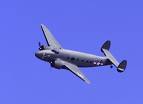
Lockheed Lodestar PV-1
**
(Until about that time, if the weather was good, aircraft were allowed to overfly the crowded airspace over major cities without contacting air
traffic control (ATC). Aircraft were only required to contact ATC within 5 miles of a major airport and only if below 2000 feet of altitude.
**
However, in the late 1960’s, because of increased air traffic and the danger of mid-air collisions, the FAA established Terminal Control Areas (TCA’s)
around all the major airports in the US.
**
These TCA’s were large areas of airspace, averaging 20 to 30 miles in diameter, extending up to 7000 feet in altitude.
**
While still free to enter and/or overfly these busy areas, aircraft first had to be identified and tracked on radar while inside the TCA).
**
Gene was an old school pilot who hated anything new and who particularly hated having to comply with the new rules pertaining to entering the TCA’s.
**
As we neared the boundary of the New York TCA, I noticed Gene had not yet tuned the communication radios to the frequency of the LaGuardia Radar
Approach Control.
Page 192
___________________________________
**
I was concerned, but, I did not dare to question Gene.
**
As we got even closer to New York, Gene seemed oblivious to the requirement that we contact the approach control prior to entering the TCA.
**
As we crossed the boundary of and entered the TCA, I suspected maybe he had forgotten about the new rules and I knew it was my duty as co-pilot to assist him.
**
So, I decided to take a chance.
**
I told Gene I believed we were already in the TCA.
**
I expected Gene to rip my face off, but he didn’t.
**
He grumbled and cursed and tuned the radio to the proper frequency.
**
He tried to call LaGuardia Approach Control.
**
They didn’t answer us.
**
He tried again. . . . . They still didn’t answer.
**
Under these circumstances, an aircraft is expected to remain outside the TCA until receiving permission to enter.
**
However, although we were now well inside the New York TCA, we still had not received clearance to enter it.
We kept proceeding toward LaGuardia Airport.
**
As it was only 6:45 AM, I mentioned that maybe there was no one in the Radar Facility. “They’re there”, Gene said.
**
As we were now only a few miles from the Airport, Gene decided to bypass the radar approach control and contact the control tower directly. He radioed
the LaGuardia Tower and told them we were about 5 miles Northeast of the airport and we were inbound for landing.
**
The tower controller began to chastise Gene for entering the TCA without permission.
**
Gene was already very agitated. He told the controller that we tried to call the approach control, but, they had not answered. He sarcastically asked
if the controller expected him to stop the airplane in flight while he waited for the Approach Control to answer.
Page 193
___________________________________
**
The tower controller replied that he expected Gene to stay out of the TCA until receiving clearance to enter it.
**
Gene told the tower controller that maybe the controllers in the radar facility should wake up and do their jobs.
**
The tower controller answered that maybe Gene should go back to school so he could learn to understand the FAA Regulations.
**
Gene told the tower controller his 90 year old grandmother could do a better job of controlling air traffic.
**
It was still very early and there were no other airplanes in contact with the Tower.
**
Gene and the tower controller argued all the way in to the airport.
**
The conversation got hotter and hotter as we got closer to LaGuardia. I was shocked and amazed.
**
I never heard a pilot say such things to a controller.
**
As we turned onto final approach, Gene and the Controller were still arguing.
***
(LaGuardia Airport is on the coast of Long Island Sound. The runway lengths have been extended onto landfills which have been built out into the water.
**
At the threshold of the runway we used, there is a dike which is about 15 to 20 feet high. This dike helps keep the sea water off the runway and also
diverts the jet blasts of the departing airliners up and away from the pleasure boats anchored in Flushing Bay).
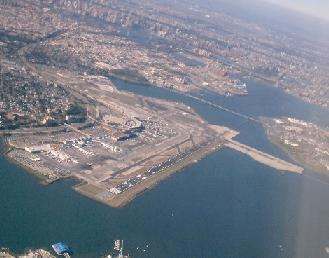
LaGuardia Airport / New York City
**
Gene made a lower than normal final approach to the runway and we barely cleared the dike.
**
As we crossed over it, the tower controller sarcastically said, “You cleared that dike by only about 3 feet”.
**
Gene snapped back, “It was exactly 3 feet”.
**
They continued their argument as we taxied to the ramp.
Page 194
___________________________________
**
When we arrived at the Marine Air Terminal (The area of LaGuardia used for private airplanes), I was relieved the ordeal between Gene and the Tower
Controller was finally over.
**
I was wrong. . . In fact, it was just beginning.
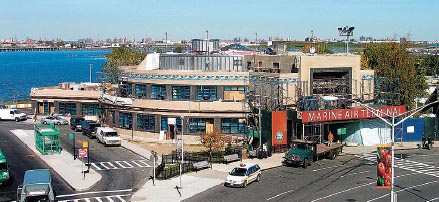
Marine Air Terminal / LaGuardia Airport
**
As we got out of the airplane, a fuel truck was already filling our tanks for the trip to Bermuda.
**
Before the fueling was finished, Gene said, “Lets go”.
**
I followed, but, I didn’t know where we were going.
**
We got into a jitney bus which took us across the airport to the main airline terminal. It was now 7:00 AM.
**
We walked through the terminal and through a series of hallways and corridors to an elevator. Gene had not said a word since we left the Marine Air Terminal.
**
Gene spoke to someone on a telephone near this elevator.
**
I couldn’t hear what he was saying.
**
We got into the elevator and up we went.
**
The elevator door opened.
**
We were high up in the LaGuardia Airport control tower.
We had a birds eye view of the entire airport, including all of the runways and taxiways.
**
We could see all the airliners parked at the main terminal and the Bomber and the other airplanes parked across the airport at the Marine Air Terminal.
**
We could also see the buildings in Manhattan, the waters of Long Island Sound, and, of course we could see the controllers in the control tower sitting
at their consoles and controlling the air and ground traffic at the airport.
**
It was still early and there was very little activity at the airport.
**
I didn’t know what Gene had in mind, but I knew I didn’t want any part of it.
**
Gene shouted, “Which one of you sons of bitches was the one I was just talking to on the radio?"
Page 195
___________________________________
**
The elevator had already left.
**
I began nervously pushing the down button to recall the elevator, but it didn’t come back.
**
The tower chief ran up to us.
**
He obviously knew Gene as he called him by name.
**
“Gene”, the tower chief said, “Please calm down”.
**
Gene would not be pacified. Gene put up his fists and yelled, “I’ll fight you bastards individually or collectively”.
**
I pushed the elevator button a little harder and faster, but it still wouldn’t come back.
**
After a 10 minute screaming match between Gene, the tower chief, and the controller who had worked our arrival, Gene finally calmed down.
**
It was obvious Gene had done this sort of thing before and was well known to these controllers.
**
I’m sure one of the reasons the tower controllers were so tolerant of Gene was they knew the owner of the Bomber, the Boss, was one of the richest
and most famous people in the World, and Gene was his personal pilot.
**
Still, it was a situation which would never be tolerated in the security conscious and intolerant environment of today.
**
Today, our entering the New York TCA without clearance and Gene’s behavior in the tower would be met with a completely different response.
**
We went back to the Marine Air Terminal to wait for our passengers to arrive. I remember thinking Gene Striker was everything I heard
he was . . . . . and more.
**
Page 196
___________________________________
**
(As mentioned, the Marine Air Terminal at LaGuardia Airport now serves as the private aircraft terminal.
This famous building on the coast of Long Island Sound, in the 1930’s and 1940’s, during what has become known as “The Glory Days of Aviation”, served
as the terminal from which the giant 4-engine Pan American World Airways Sikorsky Flying Boats (Clippers) departed on their around the world
voyages, hence the name “The Marine Air Terminal”.

PanAm Flying Boats
**
This trip to LaGuardia Airport with Gene Striker was my first visit to the Marine Air Terminal.
**
Over the next 15 years, I would visit this legendary place countless times.
**
As LaGuardia is the nearest airport to Manhattan, (The center of most activity in New York City), it is the preferred airport for all those
actually going into the City, as opposed to JFK Airport, which is much farther out and is used mostly for connecting and international flights.
**
As most prominent and/or wealthy people travel by private aircraft, the Marine Air Terminal at LaGuardia is frequented by a “Who’s - who” of America, and
of the world.
**
During my years as a pilot, I made many-many trips to New York City and spent many-many hours at the Marine Air Terminal.
**
I often saw Jackie Kennedy Onassis and her children leave for and arrive from Greece in her husband Aristotle Onassis’ private Learjet.
**
I also saw many other famous people, such as singer John Denver, actor Cliff Robertson, singer James Brown, and many-many other well known personalities
of the business and entertainment worlds, as well as many well known political figures, at the Marine Air Terminal at LaGuardia.
**
It is the center of the universe for corporate and private air travel.)
Page 197
___________________________________
**
As Gene Striker and I got back to the Bomber, our passengers were beginning to arrive. Their limousines drove out onto the ramp and up to the airplane.
**
We were all introduced and we left for Bermuda at about
8:30 AM. The controllers in the LaGuardia Tower were very courteous and polite when we taxied out and took off.
**
Gene, as always, was in the left, or, captains seat, and John Green was in the right, or, co-pilots seat.
**
I sat at a table behind them during the take-off.
**
This position had been the navigators seat when this airplane served as a military transport during World War II.
**
We climbed to our cruising altitude of 11,000 feet and headed Southeast, out over the Atlantic Ocean, toward the Island of Bermuda.
**
There were many ships entering and departing New York Harbor.
**
I watched the New York skyline disappear behind us.
**
After leveling off, Gene engaged the autopilot, slid his seat back, and began to read a magazine.
**
John Green asked Gene if it was OK if he went back into the passenger cabin to be with the Boss and his group.
**
Gene said it was OK with him.
**
As John opened the door to the passenger cabin, we could see there was a party going on back there. There was loud music playing and people
were dancing. A uniformed waiter was walking through the cabin carrying a tray which contained snacks and drinks.
**
The waiter, seeing the door to the flight deck open, brought us some sandwiches and soft drinks.
***
(For a new pilot, like myself, to be aboard a flight like
this was a unique experience. I felt very fortunate to be on this trip aboard the Bomber and to be among those people).
Page 198
___________________________________
**
At our cruising speed of 275 MPH, it took almost 3 hours for the Bomber to reach Bermuda from New York, so, I tried to relax during the flight.
**
I began to read a magazine, but, I couldn’t concentrate.
**
While at flight school in Florida, we did some overwater flying to the Islands of the Bahamas, which are a hundred or so miles off the Southeast
coast of Florida, and we had been out of sight of land many times before.
**
However, Bermuda is almost 800 miles out into the North Atlantic Ocean, which is much farther out to sea than the Bahamas.
**
I kept looking at the ocean all around the airplane.
**
It was a beautiful sight.
**
I also kept watching the fuel quantity, oil pressure, and the other gauges on the instrument panel.
**
Everything was normal.
**
John Green returned to the flight deck to instruct me on the use of the LORAN (Long Range Navigation) system so I could plot our position on
the return flight.
**
I studied many advanced navigation systems while at college, including celestial, inertial, LORAN, and others.
**
But, the LORAN set in the Bomber was extremely old and, unlike the new and more modern LORAN receivers, it was complicated to use.
**
It took about 5 minutes to plot a fix.
***
(In those days, the LORAN navigation system was implemented and was maintained worldwide by the US Navy for use by its ships,
which travel at about 20 to 30 miles per hour.
***
However, the Bomber flew at almost 300 MPH.
**
In the 5 minutes it took to plot our position using this older LORAN receiver, the Bomber traveled almost 25 miles. Therefore, the position fix obtained
using this LORAN set was only a close estimate).
***
(The LORAN system is now maintained by the U.S. Coast Guard).
Page 199
___________________________________
**
John explained how to use the LORAN receiver and, before long, I was able to determine our approximate position by using this LORAN set.
**
John said Gene would probably not ask for a position fix on the way back, but, I should probably be ready to give him one in case he did.
**
I knew that was good advice.
**
As we approached Bermuda, the Boss came into the flight deck. He told us his yacht was anchored over the sunken Spanish ship and asked if we could
make a low pass over the yacht so the people on board would know we had arrived. (No cell phones)
**
Gene said we could.
**
The yacht was anchored about 5 miles Northwest of Bermuda. Flying over it required only a minor deviation from our course.
**
We descended to about 200 feet above the water. As we passed over the yacht, Gene banked our wings, left and right, as a greeting. The people standing
on the deck waved as we flew overhead.
**
I remember thinking how very beautiful the blue and turquoise ocean and the pink beaches of Bermuda looked from the airplane.
**
We landed at the US Naval Air Station on the Island of Bermuda and parked on the civilian side of the airfield.
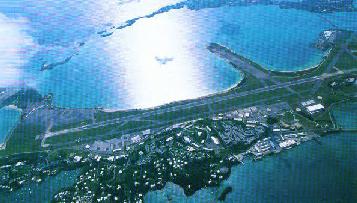
US Naval Air Station / Island Of Bermuda
**
After we landed, more limos drove up to the Bomber.
**
We all shook hands and the Boss, John Green, and their party went on their way.
**
Gene and I prepared the airplane for the return flight.
**
Gene got out of the airplane first.
**
As I got out, Gene was having a loud conversation with the driver of the fuel truck.
**
This driver appeared to be about 18 years old.
Page 200
___________________________________
**
Gene seemed upset that this fueler parked his fuel truck too close to the Bomber. (It seemed to be parked OK to me.)
**
The driver seemed a little frightened.
**
I couldn’t hear exactly what Gene was saying, but, he seemed to be inquiring as to how this fuel truck driver might feel about having a size 12 shoe
inserted into a certain part of his anatomy.
**
The driver scrambled back into his fuel truck and quickly repositioned it a little farther away from the Bomber.
**
I felt a little bad for this driver, but, compared to the incident that morning in the LaGuardia Airport control tower, this incident was relatively mild.
**
We flew non-stop from Bermuda back to Westfield.
**
Gene navigated by using a high powered radio navigation beacon which is located on Nantucket Island, off the Massachusetts coast.
**
The return flight was uneventful.
**
Gene read his magazine, while I, sitting at the LORAN navigation table, kept track of our location in case Gene asked for a position fix . . . . He didn’t.
**
As we neared Nantucket, Gene asked me to get back into the co-pilots seat. He then did something which, I was told, he had never done before.
**
He asked me if I wanted to fly the Bomber.
**
I really had no desire to fly the airplane as flying an airplane during the cruising portion of a flight is not very exciting or challenging.
**
Not wanting to appear unappreciative of this kind gesture, I told Gene I would very much like to.
**
Gene disengaged the autopilot and I took the controls.
Page 201
___________________________________
**
As we passed over Nantucket, Gene told me to make a left turn to the Northwest, toward Westfield.
**
While in the turn, he asked how the airplane felt.
**
I said it felt “Big.”
**
He laughed and said he was going to re-engage the autopilot. I had flown the airplane for about 5 minutes.
**
I thanked Gene. I felt honored.
**
After we landed at Westfield, I went into our company flight office. A few minutes later, Gene came in. He asked how much he should pay me for my
services as co-pilot.
**
I was surprised.
**
I told him todays flight to Bermuda had been a fantastic experience and I didn’t expect to be paid.
**
He said, “How about two-hundred dollars.”
**
I repeated I didn’t expect to be paid as I really didn’t do anything.
**
He shoved the money into my shirt pocket, shook my hand, and left.
**
I felt rich.
**
Two hundred dollars was over two weeks pay for me.
**
That was a day I will never forget.
- - - - - - - - -
**
A couple of months later, Gene telephoned me. He said John Green was on vacation and he wanted to know if I was interested in making another flight
with him in the Bomber.
**
I said I would like to and asked him where we were going.
**
He said I wouldn’t believe it so he would tell me later.
**
He said it would only be a short trip and we would be home by that evening.
**
When we got to the airport, before take-off, I asked Gene again where we were going.
Page 202
___________________________________
**
“You won’t believe what the Boss wants us to do,” he said,
“I’ll tell you later.”
**
We took off in the Bomber.
**
I could see we were headed toward New York City.
**
Gene told me to call LaGuardia Radar Approach Control on the radio to obtain clearance to enter the New York TCA, which I did. We landed at LaGuardia
Airport without incident and parked at the Marine Air Terminal.
**
“Are you ever going to tell me where we’re going”, I asked Gene. “You’ll find out soon enough”, he said.
**
A few minutes later, a pick-up truck drove out onto the ramp and up to our airplane.
**
“There’s our passenger”, Gene said. I looked to see two men loading a washing machine onto the Bomber.
**
“The Boss wants us to deliver this beat up old washing machine to him at his home on Marthas Vineyard“.
**
(Marthas Vineyard is another resort island off the coast of Massachusetts, near Nantucket Island).
**
“Can you believe it”, Gene said. “It costs over a thousand dollars an hour to operate this airplane. The Boss could buy 10 brand new washing machines for
what it’s going to cost him to bring this old one out to Marthas Vineyard.”
**
Gene cursed and swore for the entire flight. I sat there and listened to him vent his frustration on the Gods.
**
While I always got along well with, and I guess I liked Gene Striker, I often wondered how such a man could be the personal pilot of someone of the
stature of “The Boss”.
**
One day, a few weeks after that flight to Marthas Vineyard, I was having lunch with John Green at the Westfield Airport Restaurant, so, I asked John if he knew.
**
John said the Boss felt a strong sense of loyalty to Gene.
**
The story he told me sounded like something out of a Hollywood movie.
Page 203
___________________________________
**
It seems that one day, a few years earlier, while skiing at Aspen Colorado, the Boss had a serious accident requiring immediate treatment.
**
As Aspen is remotely located deep within the Rocky Mountains, the medical facilities there were unable to treat him. To make matters worse, there was a
severe blizzard in progress and all the roads to and from Aspen were closed.
**
According to John Green, Gene Striker flew through the blizzard and through the mountains around Aspen, managed to find the airport through the snow, and
picked up the Boss, who had arrived by ambulance.
**
Gene then flew the Boss to Denver, arriving there just in time to receive the necessary medical attention, thereby, saving his life.
**
According to John, Gene and the Boss became very close friends after that incident.
**
By the late 1960’s and early 1970’s, most people of the economic stature of the Boss had acquired jet airplanes for their personal transportation.
**
The Bomber, although plushly appointed, was an old fashioned airplane, more typical of the 1930’s or 1940’s.
The Boss had been pressuring Gene for some time to get rid of the Bomber and get them a jet.
**
But, Gene, being very set in his ways, was intimidated at the prospect of learning to fly a high altitude and high performance jet airplane and
resisted this pressure from the Boss for a long time.
**
Because of this friendship with Gene, the Boss kept the Bomber for a lot longer than he should have.
**
A year or so after our trip to Bermuda, the Boss, having given up trying to persuade Gene to get rid of the Bomber, decided to sell the airplane and to
discharge Gene and John.
**
This was also a major economic blow to our company.
Page 204
___________________________________
**
After years of pressuring Gene to sell the Bomber, we later learned that the Boss had finally purchased a luxurious private jet and hired a different
crew to fly it.
***
* * * * * * *
(Regarding the independent and sometimes defiant actions of Gene Striker and some other pilots of that era, I submit the following - -
****
I believe the Federal Aviation Regulations are
reasonable, have been formulated with the goal of
enhancing the safety of flight, and must be
respected and adhered to.
**
I do not approve of nor condone some of the actions
described in this and in some other chapters.
**
- - Having said that, I also submit the following - - -
**
Flying an airplane is an endeavor filled with many
variables and uncertainties. Only the pilot knows the
safest course of action at any given moment.
**
Sometimes (hopefully rarely), following the rules
might actually place an airplane in a more
dangerous situation.
**
( For example - when low on fuel, it may be
necessary to descend below legal landing weather
minimums during an instrument approach ).
**
There are many other similar scenarios . . .
**
It must be remembered that, unlike Doctors,
Lawyers, or many other professionals, we pilots
must suffer the consequences of our decisions,
along with our passengers.
**
In spite of our sometimes “Fun-loving” behavior,
pilots have often risen to almost “Superhuman”
levels of performance in order to save their
passengers, their airplanes, and, themselves.
Page 205
___________________________________
***
Some people believe that an independent and strong
willed nature may be a desirable asset in dealing
with the pressures and responsibilities of flying.
***
In recent years, beginning in the 1980’s, the FAA
has tightened the rules regarding aviation.
**
Many of the events described in this book, if
occurring today, would certainly result in FAA
investigations and possible disciplinary actions.
**
Today, pilots are now routinely issued violations
for even minor infractions of FAA Regulations.
**
However, as described above, not all infractions of
the rules are the result of a deliberately careless or
reckless action.
**
In earlier times, there was co-operation between
air traffic controllers and pilots.
**
We seemed to work together.
**
Today, because the FAA now disciplines air traffic
controllers for not reporting pilots for even minor
infractions of the rules, the pilot/controller relationship sometimes seems to have deteriorated into an
almost adversarial situation.
**
Controllers seemed to have been transformed from
their former positions as organizers of air traffic to
their new function as the “Air Police”.
**
Today, this added pressure, and the fear of being
issued a violation, has, in my opinion, weakened
pilots command authority, reduced our spirit of
independence and our willingness to make difficult
decisions.
**
(Although the aviation safety record may have improved since the 1980’s, I still long for and miss the freedom and independence we pilots once
enjoyed).
Page 206
___________________________________
Catch The Wind
Chapter 11
CHATEAU De AMOUR
OR
(What The World Needs Now - Is Love Sweet Love)
****
( A pilots life is not just a life of flying. . .
Sometimes the excitement and the nature
of the aviation world can create situations
which become deeply personal and can
affect someone for a lifetime.
**
One never knows when they will occur . . )
**
* * * * * * * * *
**
Upon arrival at Quebec City from Jackson that day, Carl O’Malley, Tom Williams, Bob Lamoureux, and I, went to our favorite hotel.
**
When we were in Quebec City, we always stayed at the
famous Chateau Fountainbleu Hotel. This elegant old hotel was part of a chain of luxury hotels which extended across Canada. This hotel chain was, at that time, owned by the Trans-Canadian Railroad.
**
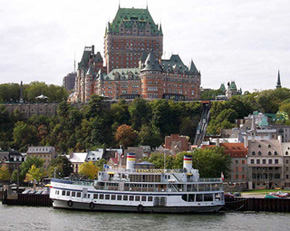
The Chateau Fountainbleu is a huge, stone-castle like structure, built high on the cliffs over the St. Lawrence River. It has huge ballrooms, uniformed bellboys, and gourmet restaurants.
**
**
Horse drawn carriages line up outside the hotel to take guests on tours of the scenic and historic French - Canadian City.
Page 231
___________________________________
**
We always enjoyed going there.
**
When we got to the Hotel, we were told our reservations had been lost and the Hotel was sold out and had no rooms available.
**
Upon hearing this, Bob Lamoureux went to a nearby payphone (no cell phones) and made a call. He returned a few minutes later and told us he just telephoned the President of the Trans-Canadian Railroad, the owner of the Hotel.
**
Bob was a major customer of the railroad and regularly contracted for hundreds of railroad cars per month in order to transport the lumber from his Jackson mill.
**
Within 10 minutes of this phone call, they were provided with a luxurious suite of rooms and I was provided with a small but elegant room in the tower overlooking the river.
**
Having risen early that day, and very tired from the stressful flight from Greenville to Jackson, I decided to go to my room to rest for a while. Although small, (there was barely enough room to stand beside the bed), the room was very comfortable and more than adequate for my short stay.
**
At about 7 PM that evening, Carl O’Malley phoned to invite me to a party they were having in their suite. I thanked Carl for the invitation, but told him of my plans to leave for Westfield early the next morning and to have some dinner before going to sleep.
**
He asked me to stop by on my way to dinner.
**
Approaching their suite, I could hear the loud music and laughter of the party all the way down the hall.
**
I had been to these parties before and knew what to expect.
Page 232
___________________________________
**
It was a typical O’Malley party.
**
There was a stripper dancing on one of the coffee tables.
**
I remember thinking how beautiful she was. There were other call-girls entertaining some of the guests and carts of expensive looking food and liquor everywhere.
**
I have always been shy around women. I always had girl-friends, but in most of these relationships, I waited for the girl to approach me first. Although I had been intimate with my girlfriends since a very young age, I was still totally intimidated and embarrassed by the type of activity going on that evening in the O’Malley suite.
**
It wasn’t that I wouldn’t have liked to spend some time with one of those girls. It was that I was young, naive, and very shy around strange women, especially the type of women in the O’Malley suite that evening.
**
Although I grew up in the sixties, I never participated in any of the hippie-type love-ins of that era, or, anything else of that nature.
**
I always had a steady girl friend and I liked it that way.
**
Although aware of my somewhat shy and reserved nature, the O’Malleys always tried to include me in their parties.
**
I usually declined their invitations.
**
However, at that moment, I wished I could loosen up a little and be more like them.
**
Carl asked again if it was possible for me to stay with them for a few days as it was important he be able to return to Westfield at a moments notice.
**
He reminded me of the almost non-existent airline service between Quebec City and Westfield.
**
I reluctantly reminded him of the agreement we made, whereby I agreed to take them on this trip but would be unable to stay in Canada with them.
**
But, I told Carl I knew how important these lumber deals were and I would probably change my mind and stay with them for as long as they needed me.
Page 233
___________________________________
**
He asked me to stay and have dinner and some fun with them that evening, but, I thanked him and left.
**
I decided to have dinner alone in the hotel coffee shop.
**
The O’Malleys had made it clear, that, on all of our trips, I was to consider myself to be one of them - that is - I could dine in any of the gourmet restaurants, order any amount of food or drink, or anything else, and charge it to them.
**
But, the coffee shop was quicker and more informal so I went there for dinner.
**
Sitting there alone in the coffee shop, I knew I could not let Carl down. This was the business world and business must come first. I knew I had to stay in case he needed me.
**
Although it had ended successfully, I was still extremely upset by that days flight through the rain and fog from Greenville to the Jackson Lodge Airstrip.
**
I wondered what ever possessed me to do such a crazy thing.
**
It seemed as though someone else was flying the airplane on that flight to Jackson and I had been only an observer.
**
As I looked at the menu, all I could see was the aviation chart on my lap and the ground speeding by below the airplane. I couldn’t help but think how easily things could have turned out differently and how lucky I was to be in this beautiful and peaceful setting.
**
I was concerned and disappointed that I had allowed myself to be pressured by my passengers into attempting this flight, and that I had become so obsessed with completing it.
**
I decided that, if I did possess exceptional flying skills, I would never allow these skills to be exploited and abused in this manner again.
**
This trip was important, but it certainly wasn’t worth getting killed for.
Page 234
___________________________________
**
I stared at the menu in a trance.
**
After putting my menu down, I looked up and saw the most beautiful young girl I had ever seen. She was sitting at the next table. I couldn’t help but stare at her.
**
When we finally made eye contact, she smiled and shyly looked away.
**
I returned my attention to my menu.
**
As the waiter approached, I discovered the menu was printed entirely in French. I asked the waiter to explain what these menu items were, but, he didn’t seem to speak English and was un-cooperative.
**
The girl at the nearby table got up and started walking toward us. I estimated her to be about 19 years old.
**
She had long, light-colored hair.
**
She was trim, but very shapely.
**
She seemed to wear no make-up and wore casual slacks and blouse. She had the sweet and innocent look of someone’s kid sister .
**
She was so beautiful . . . . I was spell-bound.
**
She said she overheard my unsuccessful attempts to order dinner and offered to translate the menu for me.
**
I was tongue-tied, stuttered and stammered, and probably said something incoherent.
**
I wanted to invite her to join me for dinner, but, as hard as I tried, the words wouldn’t come out.
**
After a long and extremely painful silence, and, with the sweetest French accent, she asked if I was alone. I told her I was. She said she wasn’t looking forward to having dinner alone and asked if I minded if she joined me.
**
I told her I didn’t mind at all.
**
It was like a dream.
**
From the time she sat down, she started talking freely with that captivating French accent. As she spoke, my head was
spinning. I didn’t hear most of what she was saying, but, I was completely enchanted by the sound of her voice.
Page 235
___________________________________
**
Her name was Nicole. She was from a small town in the central part of the Province of Quebec. She was 20 years old - - - - two years younger than I. She had come to Quebec City to apply for a job. She said she had been interviewed that day and was leaving for home soon.
- - - - - - - - - - - -
***
Sometimes, when two people meet, a certain
chemistry begins to exist between them . . . . . .
. . a chemistry which enables them to immediately
bond to one another . . a special kind of chemistry
which breaks down all walls or barriers . . .
**
To be under the influence of this chemistry is a
rare and euphoric feeling which I have experienced
only a few times in my life.
**
The chemistry between Nicole and I, that evening,
grew more and more intense . . . . .
- - - - - - - - - - - -
**
After a few seconds, I felt strangely at ease and began speaking to her as though we had known each other for years. I told her the reason for our trip and of the ups and downs of the lumber business. She seemed interested.
**
We enjoyed dinner together and soon were behaving as though we were old friends.
**
She asked if I any had plans for after dinner.
**
I told her I didn’t. She said the boardwalk and shops in the Old City down by the River were very pretty this time of night.
**
I suggested we go there. . . . She said OK.
**
We walked together on the boardwalk, looked in some of the shops, and sat on the benches by the river.
Page 236
___________________________________
**
It was a beautiful night. We had ice cream.
**
Walking down by the river, with the colored lights on the boardwalk, was very romantic. There were other couples walking hand in hand. As we started back toward the hotel, we were holding hands too.
**
It was like a dream.
**
We went back into the hotel lobby. Although I don’t drink, I suggested we have a drink in the lounge.
**
She said OK.
**
We sat in a corner booth and ordered wine.
**
There was a small band playing slow music.
**
Nicole sat very close to me. While we were there, Carl and one of his guests walked in and sat at the bar. I waved to them and they waved back.
**
I told Nicole these were the men I brought to Quebec City.
**
After a while, we danced a couple of slow dances.
**
Nicole felt warm and wonderful.
**
As we were dancing, she held her body close to mine.
**
After a few minutes of that, I couldn’t stand it any more and asked her if she wanted to come up to my room and watch TV for a while . . She said OK .
***
(When we got to the room, I remembered that, at
that time, the Chateau Fountainbleu didn’t have TVs
in the guest rooms).
**
The next morning, at about 8 AM, the phone rang.
**
Nicole was sleeping in my arms.
**
The phone woke us both. It was Carl O’Malley. He wanted to know what my plans were. I told him I would stay in Quebec City for a little longer. He asked me to check
with the hotel message desk regularly in case he wanted to
return to Westfield in a hurry.
. . . . There's lots of adventure and romance in this chapter . . .
. . . . describing some personal aspects of a pilots life . . .
Page 237
___________________________________
**
Although I told her I would call her as soon as I got back to Westfield, I didn’t. I meant to and I wanted to, but I didn’t . . .
**
Time went by and time passed by.
**
I never saw or heard from Nicole again.
**
After all these years, I still miss Nicole, think of her often, and still wonder what we may have missed.
I hope life has been kind to her.
* * * * * * * * *
***
I am fortunate to have had other similar
experiences throughout my life as a pilot.
But, if I had a time machine and if I could go
back and re-live any week of my life, I would choose
to go back and re-live the week I spent in Heaven,
with Nicole Beaudrie, at the Chateau Fountainbleu
Hotel in Quebec City . . The Chateau de Amour.
Page 246
___________________________________
|